Teachable vs Systeme.io for Your First Online Course
Teachable or Systeme.io for your first course? A plain comparison of pricing, fees, ease of use, and which one actually fits a first launch.
If you are launching your first online course and you have no audience yet, start on Systeme.io. Its free plan lets you build the course, the sales page, the checkout and the email list without paying anything, so your only real cost is your time. If you already have buyers waiting and you want the most polished student experience on day one, Teachable is the stronger platform.
Bottom line
- Systeme.io — best when your budget is zero and you need funnel, email and course in one place.
- Teachable — best when you have demand already and want a course player, payments and tax handling that feel professional immediately.
- The real question is not features. It is whether you are validating an idea or scaling one you already validated.
Teachable vs Systeme.io at a glance
| Teachable | Systeme.io | |
|---|---|---|
| Pricing model | Free plan plus paid tiers; paid plans commonly start around $39/month | Free plan plus paid tiers; paid plans commonly start around $27/month |
| Free plan / trial | Free plan exists but carries a per-transaction fee on each sale | Free plan is genuinely free forever, with contact and funnel limits |
| Best for | Creators with existing demand who want a premium course experience | First-time creators validating an idea on no budget |
| Transaction fees | Charged on the free and entry tiers; removed on higher plans | None on any plan, including free |
| Standout feature | Teachable Payments handles US sales tax and VAT as merchant of record | Full funnel builder, email, affiliate program and course hosting in one tool |
| Weakest point | Costs real money before you have made a sale | Design and page-builder polish lag behind dedicated course platforms |
Always confirm numbers on the current Teachable and Systeme.io pricing pages before you commit. Both companies change tiers.
Which one is cheaper for a first course?
Systeme.io is cheaper, and it is not close. Its free plan includes course hosting, email sending, a funnel builder and checkout with no transaction fee, so you can publish and sell a course having spent nothing.
Teachable’s free plan exists, but it takes a per-transaction cut of every sale and limits what you can publish. To remove that cut you move to a paid tier, which typically starts around $39/month. That is roughly $470 a year before your first student.
The math matters more than it looks. A first course usually sells single digits in its first month. Paying $39/month to find that out is a bad trade. Paying nothing to find that out is a good one.
Where Teachable wins on cost is the other end: at high volume, a flat monthly fee with no transaction cut beats any percentage. But that is a problem you get to have later.
Which is easier to actually launch with?
Systeme.io is easier to get to a live, selling page, because everything is in one account. Teachable is easier to get to a course that feels expensive.
Those are two different kinds of “easy” and people confuse them constantly.
With Systeme.io you build the opt-in page, the sales page, the checkout, the email sequence and the course modules inside one dashboard. No integrations, no Zapier, no second subscription for email. For a solo creator with no technical help, that removes the most common reason launches stall — half-built plumbing.
With Teachable, the course itself is the strong part. The student-facing player, the lesson navigation, quizzes, certificates and the mobile experience are more refined. But Teachable expects you to bring your own traffic engine. Its marketing pages are fine; they are not a funnel builder.
If you already have an email list somewhere else, that gap does not matter and Teachable is a clean choice. If you have nothing, Systeme.io hands you the whole machine.
What about taxes and payments?
Teachable’s payment processing acts as merchant of record, which means Teachable handles calculating and remitting US sales tax and EU VAT on the sales it processes. Systeme.io does not do this — you connect Stripe or PayPal and tax compliance stays your responsibility.
For most US creators selling to US buyers early on, this is a modest concern. Digital product sales tax rules vary by state and many creators fall under economic nexus thresholds for a while.
It becomes a real concern once you sell to the EU or UK, where VAT on digital products applies from the first sale with no threshold. At that point Teachable’s handling is worth money. This is general information, not tax advice — confirm your situation with a CPA.
Which gives you a better course for students?
Teachable. Its course player, drip scheduling, quizzes, completion certificates and mobile experience are built by a company that only does courses.
Systeme.io hosts courses competently, but the student area is plain. Video, text, modules, drip — it works, and nobody has ever asked for a refund because the lesson sidebar was unremarkable. Still, if your course sells at a premium price and buyers are comparing you to polished competitors, presentation carries weight.
A practical rule: under roughly $200 a seat, students care about the content and almost nothing else. Above that, the wrapper starts affecting perceived value and refund rates.
Who should pick Teachable
Pick Teachable if you already have an audience — an email list, a YouTube channel, a client base — and you are converting existing demand into a paid course.
Pick it if your course is priced high enough that a professional student experience protects your price point. Pick it if you sell internationally and want sales tax and VAT handled rather than tracked by you.
Pick it if you want one tool that does one thing well and you are happy to run email marketing somewhere else. Start with Teachable if that describes you, and read our Teachable review for the tier-by-tier detail.
Who should pick Systeme.io
Pick Systeme.io if this is your first course and you have not proven anyone will buy it.
Pick it if your budget for tools is zero, or close to it. Pick it if you need landing pages, an email list and checkout as much as you need course hosting. Pick it if you want a built-in affiliate program without paying extra — Systeme.io includes one even on the free plan, which is unusual.
Pick it if you would rather spend the next ninety days finding out whether the idea works than configuring five separate subscriptions. Get the free Systeme.io plan, or see exactly what the free tier includes in our Systeme.io free plan breakdown.
Can you start on one and move to the other?
Yes, and plenty of creators do. Migrating course content is manual but not hard — you are re-uploading videos and rewriting lesson descriptions, typically a weekend of work for a normal-sized course.
The part that hurts is your email list and your links. Every place you have published a sales page URL has to be updated, and email subscribers have to be exported and re-imported with tags rebuilt by hand.
Our honest advice: start where the risk is lowest, which is the free option, and only migrate once the revenue makes the migration worth a weekend.
FAQ
Is Systeme.io’s free plan really free?
Yes. Systeme.io’s free tier has no time limit and no transaction fee, with caps on contacts, funnels and courses rather than a trial clock. You will eventually outgrow the contact limit if your list grows, and that is when a paid tier makes sense.
Does Teachable have a free plan?
Teachable offers a free plan, but it applies a per-transaction fee to each sale and restricts some features. It works for testing the platform; it is an expensive way to sell at any real volume, so most creators move to a paid tier once sales are steady.
Which one is better for selling coaching, not courses?
Teachable, generally. It has native coaching products with scheduling and session handling built in. Systeme.io can sell a coaching package through its checkout, but you will handle booking with a separate tool like Calendly.
Can I use both?
You can, and it is a reasonable setup: Systeme.io for funnels and email, Teachable for course delivery. It costs two subscriptions and adds a handoff between checkout and enrollment, so most solo creators are better off consolidating until volume justifies the complexity.
The move to make this week
If you have never sold a course, open a free Systeme.io account today, build a one-page sales page and a three-module outline, and try to sell it before you record a single lesson. Zero spend, real signal.
If you already have people asking to buy, skip the validation step and set up on Teachable — the polish and the tax handling pay for themselves once money is actually moving. Either way, the platform is the small decision. Whether anyone wants the course is the big one.
Tools mentioned in this article
Keep reading
Teachable Pricing: Which Plan Actually Pays Off?
Teachable pricing explained plan by plan, plus the simple revenue math that tells you exactly when an upgrade pays for itself.
How to Sell an Online Course on Teachable: Setup to First Sale
Step-by-step guide to selling an online course on Teachable: pick a plan, build your course, set pricing, launch a sales page and land your first sale.
Best Online Course Platforms for Creators
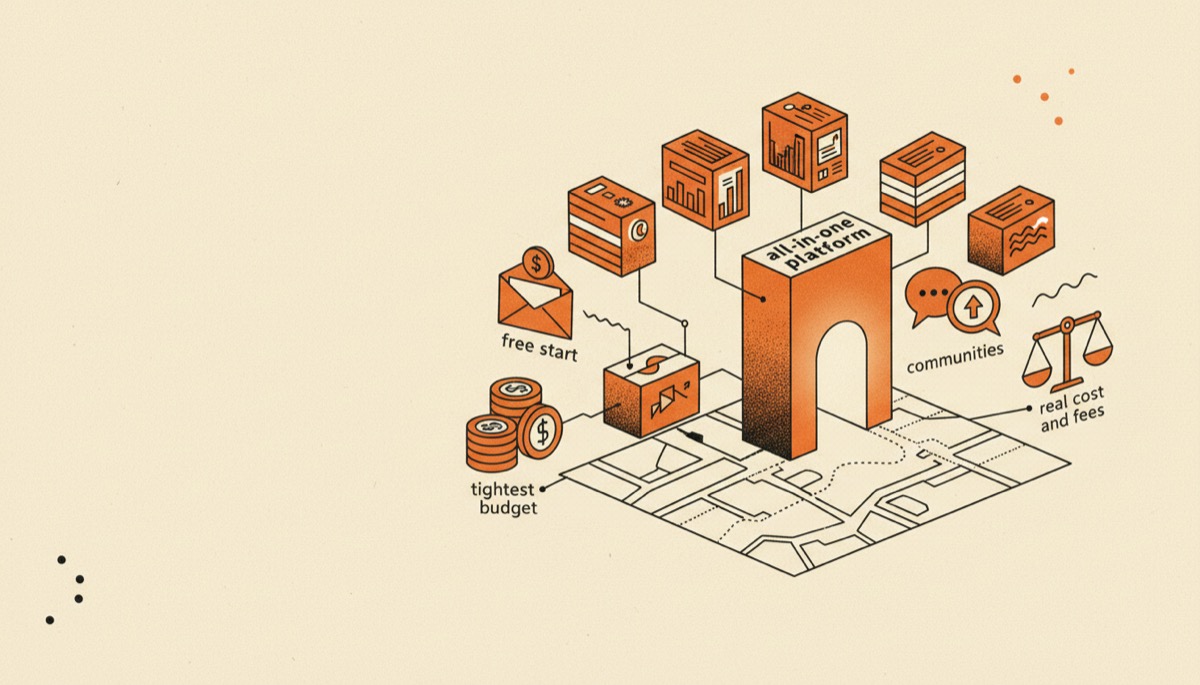
Seven course platforms compared by real cost and fees, with a clear pick for a free start, all-in-one, communities, coaching and the tightest budget.

Kajabi Review: Worth the Price, or Overkill?
An honest Kajabi review: what the all-in-one price really buys, which creators get their money back, and who should pick something cheaper instead.